
Linn County Projected vs Actual Release
A projected or scheduled date answers what the current calculation expects. An actual release date records when custody ended. Linn County Jail and Oregon DOC make separate calculations under separate rules. The Sheriff's detail can display a person-level Scheduled Release Date and charge-level Release Date fields. Oregon DOC calls its sentence estimate a Projected Release Date, or PRD. Neither prediction by itself proves that a person walked out, transferred, or reached full discharge.
A charge-level release date can show that one charge no longer holds the person while another charge, sentence, warrant, or detainer keeps custody in place. A future DOC PRD likewise means the person remains in state custody under the current computation. The actual jail movement record or DOC discharge entry is the stronger record of the completed event.
Scheduled versus actual: A scheduled or projected date can change. Verify the final event with the holding agency, especially when another charge, court order, or hold may remain.
A pretrial detainee is different. With no custodial sentence yet, there is no earned-time computation that fixes an exit date. Security, conditional release, dismissal, a court order, and other holds control. The roster's blank Scheduled Release Date does not mean the person will be held forever, and a populated date is still subject to court and custody changes.
Find a Linn County Projected Date
First identify the present custodian. A person held at Linn County Jail follows the county route. A person serving an Oregon prison sentence follows the DOC route even when the case began in Linn County. County of conviction does not identify the prison. If a current jail name disappears, determine whether the person entered the community or transferred before relying on a different system's date.
- Check the LCSO Current Adults in Custody roster. Note its timestamp and open the correct detail.
- Record the LCSO ID, Date Lodged, every court and docket, the person-level Scheduled Release Date, and each charge-level Release Date.
- For a county sentence, compare the judgment and credit for time served. Ask jail records for the current computation if the date is blank or changes.
- For state custody, open Oregon Offender Search, accept its disclaimer, and search by first, middle, last name, or SID.
- Read the release-date label actually shown on the matching OOS detail. Confirm identity and treat a future date as a projection.
- Check VISOR for a current custody or supervision result and notification option. Compare it with OOS rather than treating the services as identical.
- Use the judgment, amended judgment, jail release record, or DOC certified record when formal confirmation is needed.
The Linn County released-inmate search explains the full custodian decision tree. It also covers court, federal, and immigration branches when the jail roster alone cannot explain where someone went.
Note: The LCSO roster shows current jail custody, while OOS serves Oregon DOC records; neither should be relabeled as the other's release-date system.
Oregon DOC Dates for Linn Cases
Oregon Offender Search, or OOS, is the official DOC public offender application. The search form provides separate First, Middle, Last, and SID fields and permits an asterisk wildcard for partial matching. A SID is DOC's unique identifier and is more dependable than a common name. OOS warns that public information is periodically updated, may change, and is not an official record.
Oregon DOC's sentence-recalculation material identifies OOS as the official place to view an offender's release date and calls the computed date a PRD. The literal label on a live detail should be read as shown because the public interface may change. The date reflects the judgment, sentence structure, jail credit, statutory eligibility, projected earned time, and later changes known to DOC.
The Oregon Offender Search application appears in the captured source below. It is suited to a sentenced state prisoner, not a pretrial Linn County jail detainee.
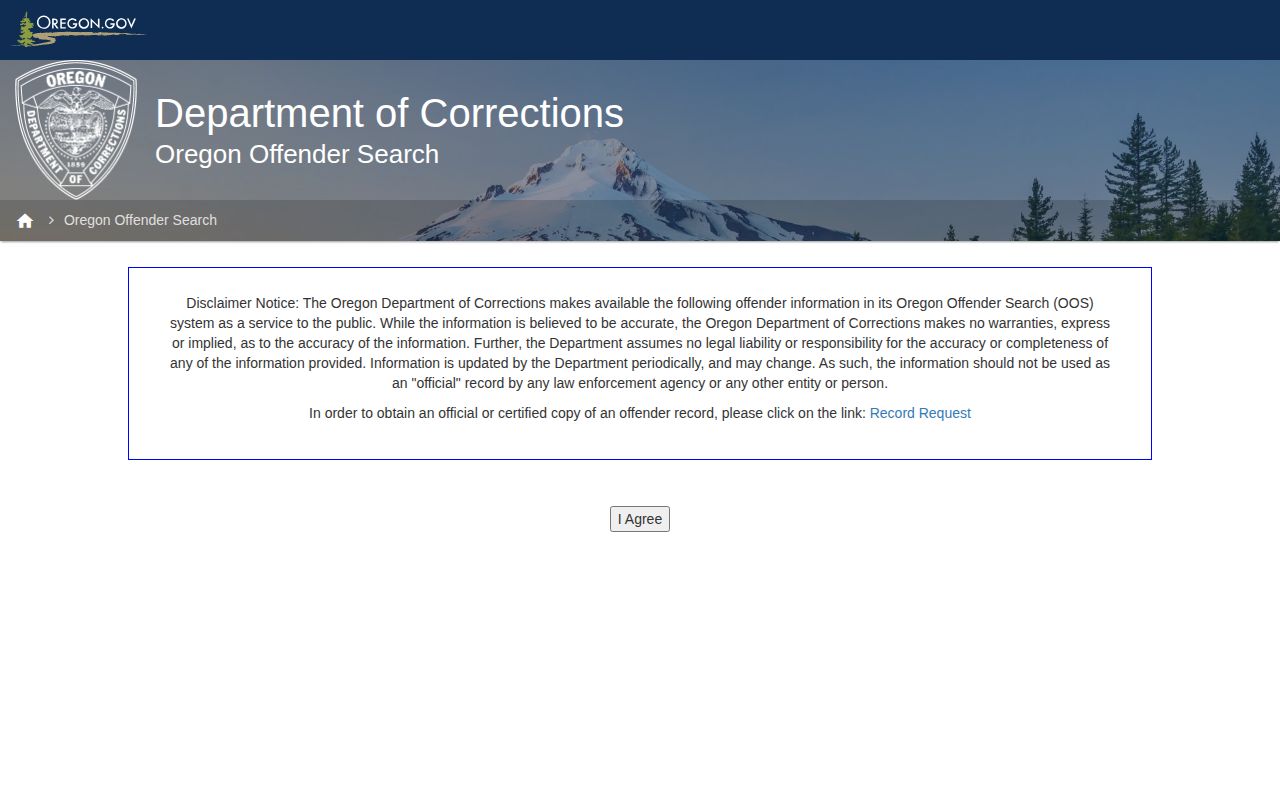
The official search supplies a current estimate. For a certified offender, release, or discharge record, use the Oregon DOC Public Records Center instead.
Linn County Jail Good-Time Schedule
County jail good time is a local sentence calculation, not the Oregon DOC earned-time rule. Under ORS 169.110, the sheriff or custodian may grant deductions to a sentenced county prisoner who faithfully observes facility rules. The statute makes the deduction discretionary and ties it to definite sentence lengths. It does not create a release promise for a pretrial detainee.
| Definite county sentence | Authorized good-time schedule |
|---|---|
| 10 through 30 days | One day for each ten days |
| More than 30 through 90 days | Three days for each 30-day period |
| More than 90 through 180 days | Four days for each 30-day period |
| More than 180 through 270 days | Five days for each 30-day period |
| More than 270 days | Six days for each 30-day period |
Authorized time in an alternative sentencing facility can qualify if the county governing body has allowed it. The judgment, credit already served, consecutive or concurrent terms, disciplinary history, and other holds still affect the operational date. Arithmetic based only on the length of one charge can therefore be wrong.
The Sheriff's roster image below comes from the current Linn County roster. Its details can show Scheduled Release Date and charge-level Release Date fields, but the roster is not a former-inmate archive.
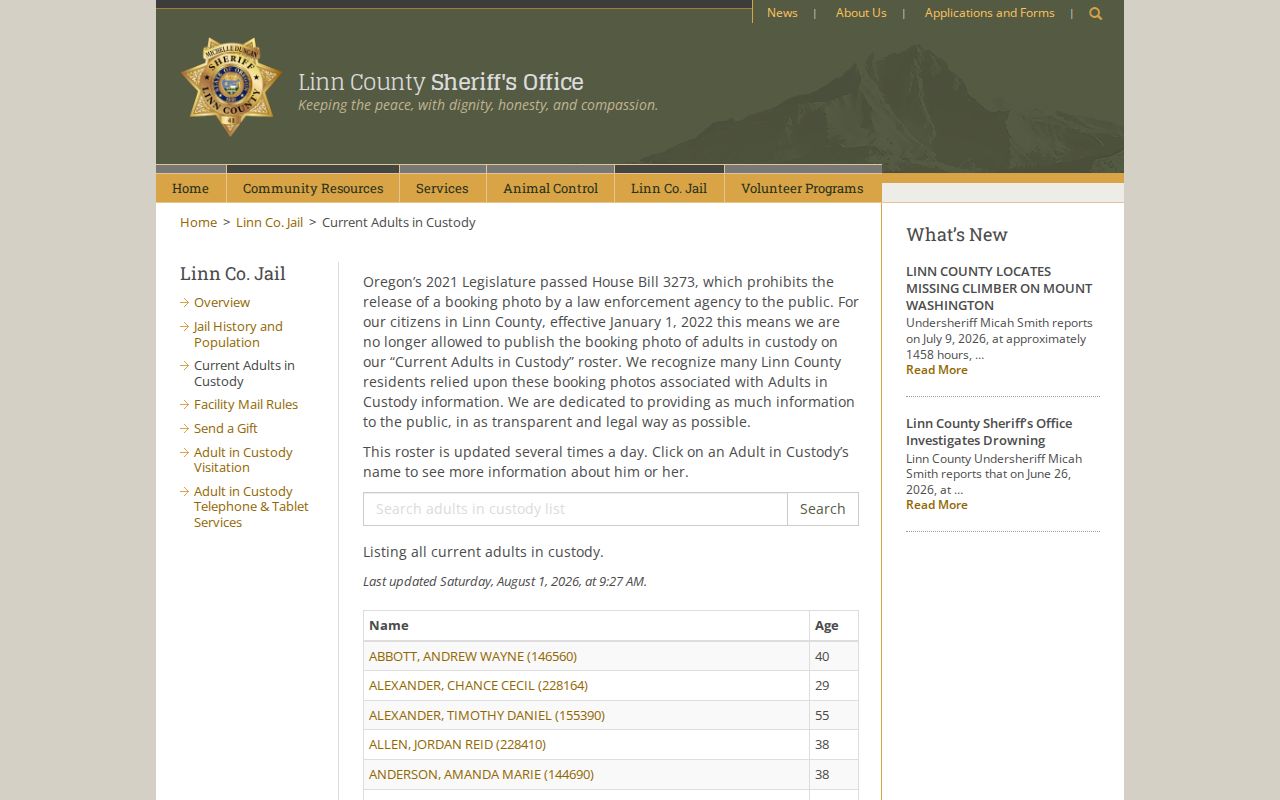
Once a name leaves the current roster, request the retained release or movement entry rather than assuming the scheduled date became the actual exit date.
Linn County State Earned-Time Rules
A state prisoner whose case arose in Linn County is governed by DOC sentence computation. ORS 421.121 authorizes earned-time reductions for eligible sentences based on appropriate institutional behavior and participation. Limits depend on the statutory version, sentence category, judgment, offense date, and exclusions. Oregon materials distinguish cases with reductions capped at up to 20 percent, those limited to 10 percent, and sentences excluded from that reduction. A flat percentage should not be assigned without reading the controlling record.
There is no universal Oregon rule that every person serves exactly 85 percent. Measure 11 mandatory minimums under ORS 137.700 and ORS 137.707 generally require the stated minimum, subject to specific later laws and court-dependent exceptions for defined people. ORS 137.635 supplies an express 85-percent floor for listed determinate repeat-felony sentences: an eligible reduction cannot take the imposed term below that floor. The judgment and offense date must control the calculation.
OAR 291-100 defines PRD as a calculated date that assumes compliance with projected earned-time credits. Court judgments can also authorize presentence credit under ORS 137.370. Those inputs show why the sentence length in a judgment may differ from the current OOS date without either figure being a simple error.
The DOC sentence-recalculation FAQ documents a current Oregon-specific source of change. A state Supreme Court interpretation altered how some qualifying sentences receive presentence time-served credit, and DOC says affected calculations are reviewed automatically.
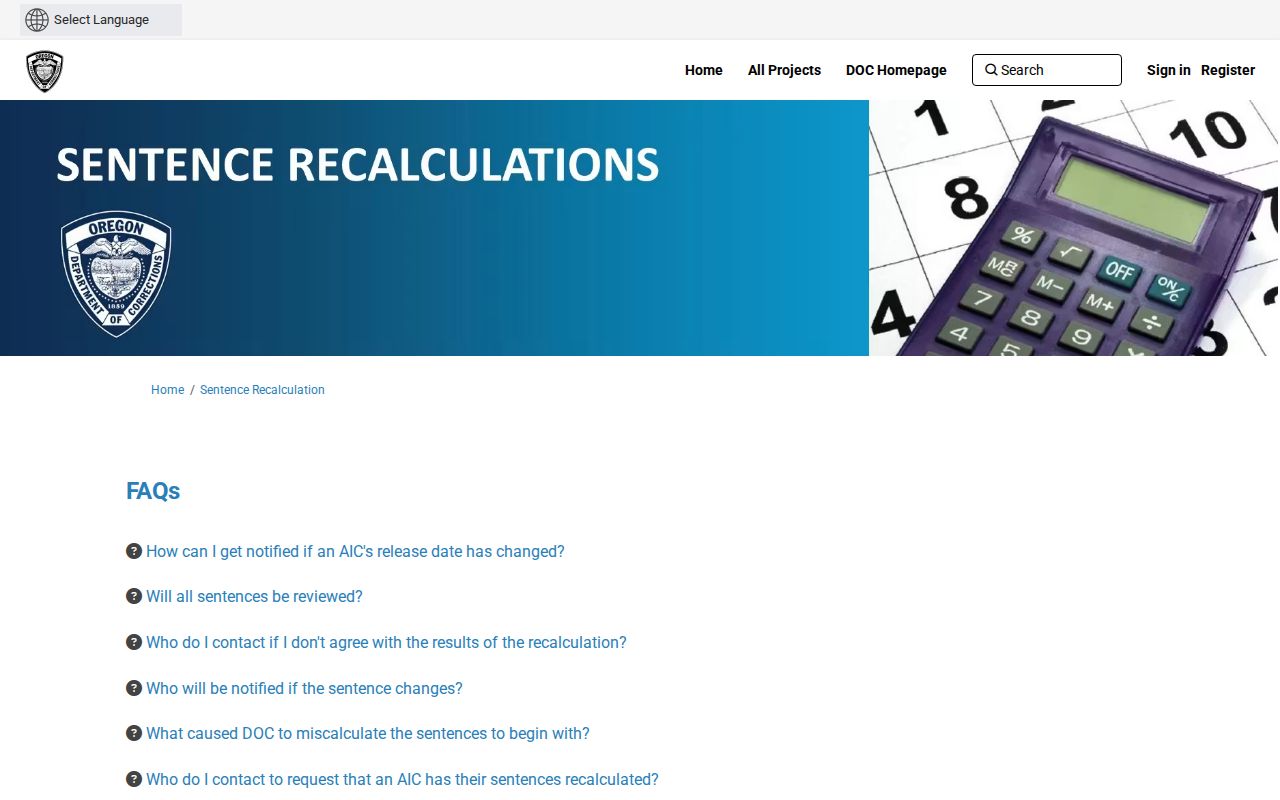
DOC says qualifying changes appear through OOS, while VISOR can send an alert on its notification cycle. The agency does not provide individual recalculation status updates through the FAQ.
Why Linn County Release Dates Change
A date can move because a legal input changes, new custody is added, or assumed credit no longer applies. The direction is not always later. Added time or lost credit can postpone release, while an amended judgment or newly recognized credit can move the date sooner. The current agency computation is more useful than old arithmetic saved from an earlier search.
| Factor | Possible effect | Best source |
|---|---|---|
| Amended judgment | Changes sentence terms or authorized credit | Sentencing court and DOC computation |
| Presentence credit | May reduce remaining custodial time when lawfully granted | Judgment, ORS 137.370, and DOC |
| Earned-time loss or restoration | Moves the state PRD later or earlier | DOC computation record |
| Additional or consecutive term | Adds custody after another term | Judgments and sentence structure |
| Detainer or hold | Can block community release or cause transfer | Holding and receiving agencies |
| Parole review or postponement | Can set, affirm, defer, or postpone a parole date | BOPPPS final action |
| Escape or inoperative time | Can stop credit from running for a period | DOC calculation and official record |
Release-plan constraints can also affect when an authorized release is carried out. A parole calendar is only notice of a hearing. The written BOPPPS action states whether a date was set, affirmed, deferred, postponed, or denied. Missing the distinction can turn a possible date into a false claim of release.
Note: A Linn County charge can be released while another charge or detainer remains, so read every docket and status on the jail detail.
Linn County Court and Parole Dates
The Linn Circuit Court record supplies the sentence inputs for a case filed there. The Register of Actions can show release or security orders, sentencing, an amended judgment, probation action, and later set-aside proceedings. The judgment states the sentence and can address credit. A court order may authorize release, but the jail or DOC movement record establishes when custody was physically completed.
Parole eligibility also cannot be reduced to one statewide number. ORS 144.120 and ORS 144.125 govern initial date setting under the applicable indeterminate system, review, and postponement. Sentence type and offense-date law matter, while many modern determinate terms lead to post-prison supervision instead of discretionary parole. A BOPPPS final action is needed when a Board decision changes the applicable date.
Probation is usually a court community sentence and may begin without a prison release at all. Post-prison supervision starts after many modern prison terms. Both mean the person can be outside the building while still subject to legal supervision. A projected custody-end date therefore should not be described as the end of the whole case.
Confirm Linn County Actual Release
Near the projected date, check the system that holds the person. For Linn County Jail, review the current roster and call 541-967-3901 if immediate clarification is needed. For state custody, review OOS and VISOR. Registering through the Linn County VISOR check can provide a notice for release, facility movement, or a PRD change.
VISOR works on a two-hour notification cycle for the events described by DOC. It is not instantaneous. A temporary facility-feed interruption can also delay the search or alert. A notice should be paired with the final jail or DOC record when the exact date, time, manner, or receiving agency matters.
Request a Linn County booking sheet plus the actual release date and time, release manner, and transfer destination when applicable. For a state prisoner, request an official or certified offender record, release or discharge entry, computation material, and relevant sentence order through DOC's Public Records Center. Those records distinguish a forecast from the event that actually occurred.