
Linn-Benton Youth Release Paths
The official Linn County facility description identifies a county juvenile detention partnership serving Linn and Benton counties. Youth may arrive through law enforcement, a court hearing, or a probation officer. The legal route into detention affects the route out. A judge may direct release to a parent or another responsible placement, while a probation officer may supervise a conditional-release agreement.
Conditional release does not mean that every juvenile-court duty has ended. It is a supervised step outside the secure detention setting. The youth must follow the agreement and court directions, and a violation may lead to return to detention. Other changes may involve a treatment setting, foster or residential placement, or movement within the youth-custody system. Those changes should be described as placements or transfers unless the responsible juvenile authority confirms community release.
| Youth-system outcome | What it means | Who confirms it |
|---|---|---|
| Conditional release | The youth leaves secure detention under stated conditions | Assigned juvenile probation professional or court |
| Return to parent or guardian | A court-directed community placement | Court order and authorized case contact |
| New youth placement | Custody or supervision continues in another setting | Juvenile department, OYA, or committing court |
| Return after violation | The conditional arrangement changed and detention resumed | Juvenile probation and court record, subject to access limits |
Linn-Benton Release Confidentiality
Youth records are not handled like adult county-jail entries. Juvenile case and custody details may be confidential, withheld from online systems, or available only to a youth, parent or guardian, lawyer, victim with defined rights, or another authorized participant. A lack of public information does not show that the youth is still detained, has been released, or was never held.
The protected status also changes how questions should be asked. Staff may need to verify identity and authority before discussing placement or release terms. They may provide only safe, limited information. Public adult-search methods should not be used to work around that limit, and no one should post a youth’s identity, address, case detail, or movement based on rumor.
Oregon court systems also restrict protected juvenile material. A public adult court search may return nothing even when an authorized juvenile case exists. The right route is the contact already assigned to the case, not an attempt to infer status from silence.
Note: Confidentiality protects youth and can lawfully limit even basic status details provided to a person without verified authority.
Confirm Linn-Benton Youth Release
An authorized person should begin with information already supplied by the juvenile department, court, lawyer, or assigned probation professional. Case-specific names and numbers are more reliable than a general web search. The goal is to verify the current lawful placement and any next step without asking an adult jail or adult corrections database to answer a youth question.
- Locate the case notice, conditional-release agreement, court order, or contact sheet. Use the case number and assigned professional shown there.
- Call the Linn-Benton Juvenile Detention Center only when the caller is entitled to seek the information. Be ready for identity and authority checks.
- Contact the assigned juvenile probation professional for the current conditions, reporting plan, and approved placement. Do not rely on a third party’s account.
- Ask the lawyer or committing court for the releasable order when written proof of the legal decision is needed.
- If OYA placement is involved, use OYA and the assigned OYA professional. A county detention release may be followed by another youth placement.
A simple question can prevent a major error: “Was this a release to an approved community placement, a conditional release, or a transfer within youth custody?” The answer identifies whether secure detention ended and whether legal custody or supervision continued elsewhere.
Linn-Benton Release Contact
The facility contact is appropriate for operational questions from authorized people. It is not a public youth-search line. Staff can decide what may be confirmed under juvenile confidentiality rules and may direct the caller to probation, counsel, or the court.
Linn-Benton Juvenile Detention CenterOak Creek campus
4400 Lochner Road SE
Albany, OR
Phone: 541-791-9397
Release information: authorized juvenile-case channels only
The county page is the official public source for the program description and main facility number. It does not publish an adult-style booking search, release list, or open directory of detained youth. Calling does not guarantee disclosure. The facility must protect the youth and follow court and juvenile-department rules.
When written confirmation is required, ask the assigned lawyer or juvenile professional which agency holds the releasable document. A court order, conditional-release agreement, probation record, and facility movement record serve different purposes. Requesting the right record from the right custodian is safer than asking for a broad “youth release report.”
Linn-Benton Detention Center Facts
The Linn-Benton Juvenile Detention Center opened on December 15, 1997. The county describes it as a 20-bed partnership, with Benton County contracting for beds. It is located on the Oak Creek campus in Albany. These facts identify the center, but they do not make it the same program as the other youth operations at that address.
Youth enter this detention center through law enforcement, a court hearing, or probation action. That short-term county role differs from an OYA secure correctional placement or a secure transition program. The operator and committing authority should be checked before anyone uses the word “release.”
The county’s youth detention source shows the facility description used here.
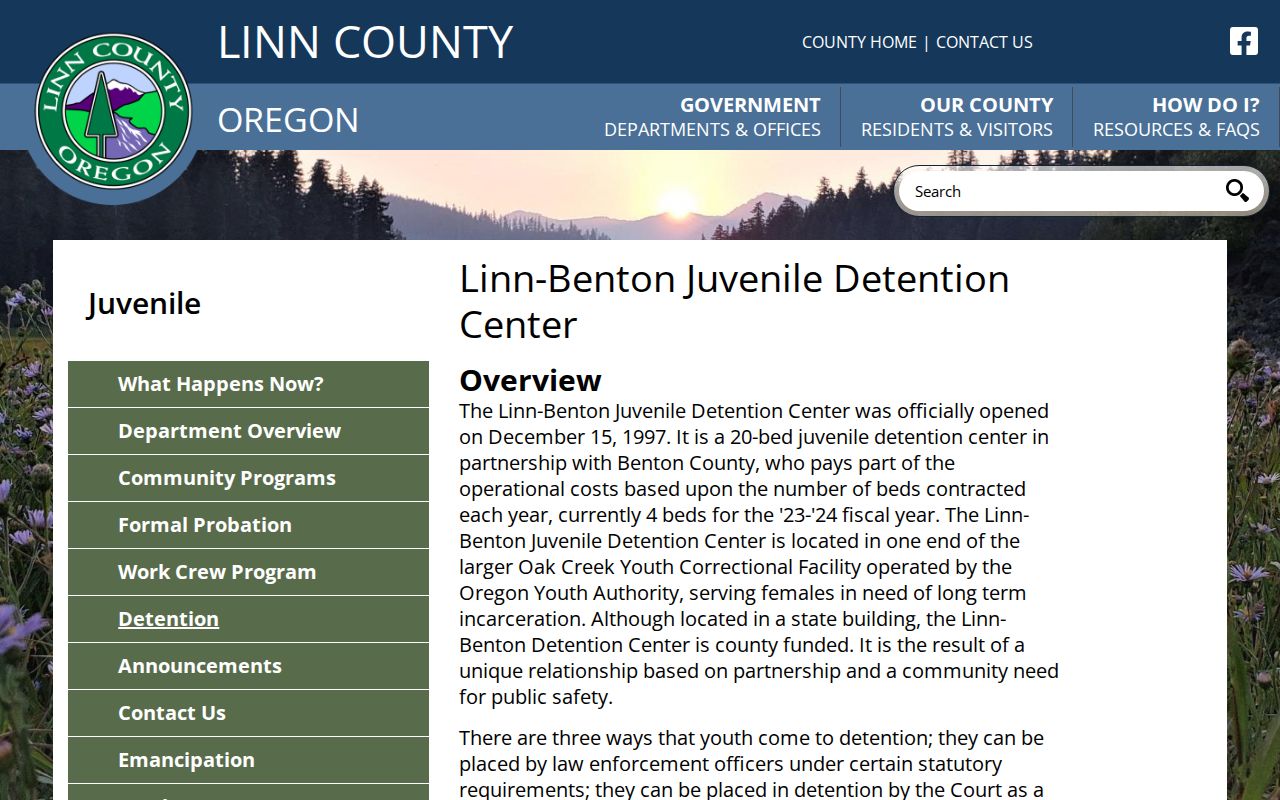
The source supports the partnership and conditional-release route while preserving the line between public program facts and confidential youth information.
Linn-Benton Conditional Release
A conditional-release agreement permits a youth to leave detention under specific terms and supervision. Juvenile probation monitors compliance. The agreement can address where the youth may live, whom the youth must contact, court appearances, services, school, safety steps, or other case-specific duties. Those terms must come from the actual agreement or responsible professional. They should never be guessed from the type of charge or length of detention.
A return to detention for a violation does not erase the first release event. It means the supervised release plan changed after alleged or established noncompliance under the juvenile process. An authorized person seeking a timeline may need the court orders and probation record, subject to access rules, rather than a single facility status statement.
- Conditional release
- Departure from secure detention under stated rules and juvenile probation supervision.
- Placement
- The setting approved for the youth, which may be in the community or another controlled program.
- Transfer
- A move between custodians or programs that does not itself prove unrestricted community release.
- Discharge
- The formal end of a specific custody or supervision authority, as shown by the responsible agency or court.
Note: A conditional release ends secure detention for that period, but court authority and juvenile probation supervision may continue.
Linn-Benton Campus Release Boundaries
Three named youth functions are tied to the Oak Creek address. Linn-Benton Juvenile Detention Center is the county partnership. Oak Creek Youth Correctional Facility is an Oregon Youth Authority secure correctional facility. Jackie Winters Transition Program is an OYA secure transitional program. Co-location does not turn them into one institution or one release route.
A move from county juvenile detention into OYA custody continues youth-system control. A move from Oak Creek into Jackie Winters is a placement transition, not proof of community discharge. A youth who goes home under a conditional agreement may still be supervised. Precise language protects against telling a family that custody ended when the youth only moved between programs.
| Program | System | Status route |
|---|---|---|
| Linn-Benton Juvenile Detention Center | County juvenile partnership | Juvenile department, court, and assigned probation |
| Oak Creek Youth Correctional Facility | Oregon Youth Authority | OYA and committing court |
| Jackie Winters Transition Program | OYA secure transition | OYA and assigned parole or probation professional |
Linn-Benton Adult Search Boundary
The Linn County Sheriff’s adult roster concerns current adults held at Linn County Jail. It is not a youth release source. Oregon Offender Search is an Oregon DOC adult system and should not be represented as a standard OYA locator. VISOR instructions for adult county or state custody also should not be promised as a public youth search path.
Age alone can create confusion because OYA may serve some young people committed through different legal routes. The controlling system remains OYA and the committing court. Use the case paperwork and agency named there. If the person has moved into an adult corrections system under lawful authority, that custodian can explain its own public process, but no such move should be inferred from a missing youth record.
The safe conclusion is narrow. Public sources confirm that the center exists and explain its program. Only authorized juvenile-system sources can confirm an individual youth’s release, conditions, placement, or discharge.