
Understanding Linn County Releases
A release from Linn County Jail means the Sheriff's Office no longer holds the person in that jail stay. It does not always mean the person walked into the community. Bail, a court order, dismissal, sentence completion, and a transfer can all end local custody. A transfer may lead to Oregon Department of Corrections custody, another county jail, a hospital, federal detention, or immigration custody. The agency that receives the person then becomes the best source for present custody status.
The live roster answers a narrow question: who is shown as held at Linn County Jail when the roster was last updated? It does not preserve a public list of former entries. A missing name is thus a clue, not proof of community release. VISOR may show current custody or supervision. A Sheriff release or movement record can document the actual event. The named court can show the legal order behind it.
- Release
- The end of one custodian's control, either to the community or through a transfer.
- Discharge
- The formal end of a sentence or supervision term, which is different from leaving a building.
- Time served
- A sentence satisfied by credit for time already spent in custody.
- Detainer
- A request or legal hold that may send a person to another authority instead of the community.
Linn County Release Types
The exit type controls the next search. A pretrial adult may post the court-set security or receive conditional release. A sentenced person may complete a county term. Someone else may leave because the case was dismissed, the court imposed probation, or another authority took custody. The same roster change can therefore point to very different records.
| Release or movement | What it means | Best next check |
|---|---|---|
| Bail or conditional release | Local custody ends under court-set terms. | Jail release entry and the court docket |
| Time served | A definite county term has been completed. | Release record, judgment, and computation |
| Probation | The court orders community supervision, sometimes without a prison term. | Court judgment and Linn Community Corrections |
| DOC transfer | County custody ends but state prison custody starts or continues. | Oregon Offender Search and VISOR |
| Federal or ICE transfer | Another authority receives the person under its own case or hold. | BOP, ICE, federal court, or receiving agency |
Roster removal proves only that Linn County Jail no longer displays current custody. It does not identify the release manner or destination.
Linn County Release Record Fields
Linn's current booking detail provides useful links between the jail stay and the court case. Its public fields can include the name, LCSO ID, age, Date Lodged, Arresting Agency, Scheduled Release Date, charge, docket, court, security or bail, status, and a charge-level Release Date. These fields are not all the same. A scheduled date may change, and a charge-level date does not prove the moment the person left when another charge or hold remained.
A written request should ask for the custody-ending event in direct terms. That reduces the chance of receiving only a booking sheet. The release or movement record is the strongest county proof of when custody ended and whether the person went to the community or another authority.
| Field | What it can establish |
|---|---|
| LCSO ID and booking identity | Connects the requested record to the correct jail stay. |
| Actual date and time | Shows when Linn County custody ended. |
| Release manner | Identifies bail, court order, sentence completion, or another event when retained and releasable. |
| Destination or receiving agency | Separates community release from custodial transfer. |
| Court and docket | Points to the case record that authorized or explains the action. |
| Supervision information | Shows whether probation, parole, or post-prison supervision may follow. |
The official current roster displays only current adults in custody and is updated several times each day. The timestamp should be recorded before drawing any conclusion from presence or absence.
Request Linn County Release Records
The Linn County Sheriff's Office requires a written Request for Copies of Records. It accepts the form in person or by mail, by fax at 541-967-8169, or by email at Records_Reports@linnsheriff.org. Include the full name, LCSO ID if known, approximate lodging date, docket, and a narrow date range. Ask for the booking sheet plus the actual date and time custody ended, the release manner, and any releasable destination or receiving agency.
- Identify the exact jail stay with the person's name, local ID, and booking or lodging date.
- Specify the release fields, movement entry, and transfer destination needed.
- Submit the official written form through an accepted channel.
- Review any clarification or cost estimate before paying.
- Compare the response with the named court's order or judgment.
The posted schedule lists a $10 booking sheet. General records cost $12 for the first 25 pages and $0.25 for each extra single-sided page. Rich media and redaction have separate staff-time charges. LCSO does not promise a fixed completion day; extensive requests may take longer and authorized staff review records before release.
The LCSO records-request page shows the current channels and fees.
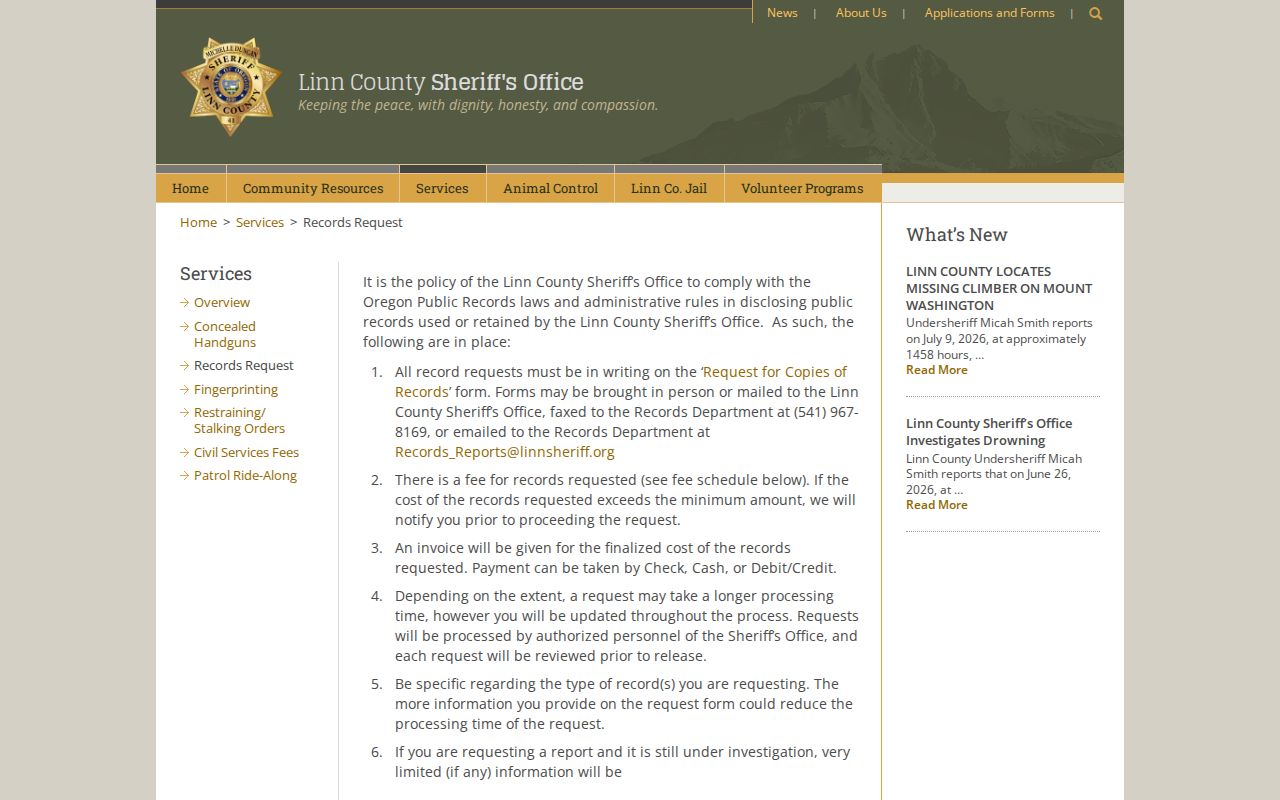
The official page helps distinguish a durable written record request from a quick check of the changing jail roster.
Linn County Release Record Law
Oregon Public Records Law, chiefly ORS 192.311 through 192.478, starts from access to nonexempt records held by public bodies. ORS 192.324 permits fees tied to actual costs and sets the response process. Public does not mean that each field must be free or instantly online. The custodian may search, review, redact, and apply a specific exemption.
Active-investigation, safety, privacy, juvenile, medical, sealed, and set-aside limits can affect a response. Linn County has not published a standard online retention period for former roster entries. Website removal is not the same as destruction of the underlying record. A narrow request should ask the custodian to cite the legal basis for any withheld part.
Under ORS 137.225, a qualifying court set-aside can change how an arrest or conviction record is treated. Eligibility depends on the case and current law. The court order and the agency's present response are more reliable than an old copy found elsewhere.
Find Linn County Released Inmates
A complete search starts with the system that last held the person. The Linn roster is useful only for present local custody. Oregon's tools cover state custody and supervision. The court docket explains legal action, while the Sheriff's movement record proves the physical exit. Federal paths apply only when a federal or immigration transfer is plausible.
- Check the Linn County current roster and note its timestamp.
- Search Oregon VISOR by name, SID, or County ID for current custody or supervision.
- Use Oregon Offender Search when a state prison stay or former DOC record is possible.
- Follow the Court and docket fields to the correct court, not automatically to Linn Circuit Court.
- Check BOP or ICE only when the case or hold points to federal authority.
- Request the Sheriff release or movement record when online sources do not settle the outcome.
For a defined same-day interval, the Linn County 24-hour release process explains how to request a time-bounded event report. It does not claim that the Sheriff publishes a missing feed.
Oregon Search for Linn Releases
The Oregon Offender Search is the main public path for a person who entered Oregon DOC custody. Search by first, middle, or last name or by State Identification Number. Wildcard matching can help with uncertain spelling, but identity must be checked against the returned details. OOS is not the Linn jail archive, and a county booking alone does not ensure a state result.
| Search field | Use | Limit |
|---|---|---|
| First, middle, last name | Find a person without an ID. | Common names need identity checks. |
| SID | Targets an Oregon state identity. | Use the full correct number. |
| Status and location | Separates state custody from a released or supervised result when displayed. | Public data is not a certified record. |
| Projected release date | Shows DOC's current computation when applicable. | Projected is not the final release event. |
The live Oregon Offender Search, reached through the official Oregon DOC gateway, warns that its public display should not replace an official or certified record.
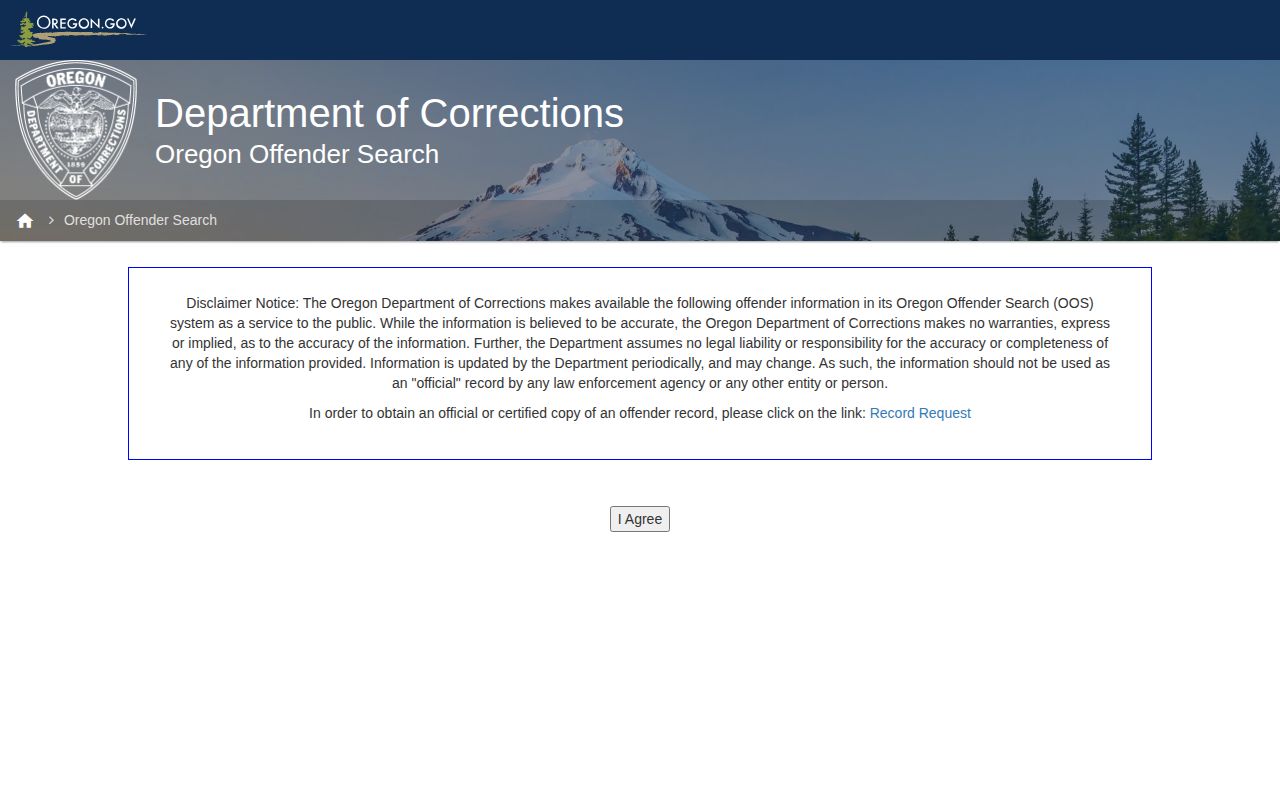
The search fields show why a state offender lookup is a different task from checking the current Linn County jail roster.
VISOR Tracks Linn Release Status
Oregon ended VINE on October 31, 2023. The current service is VISOR. It combines county and state custody information for people currently in custody or under supervision. Searches accept a full or partial name, SID, or County ID. A matched detail can show identity, custody status, location, supervision, and a projected release date when applicable.
VISOR also offers confidential, opt-in alerts by phone, text, email, or TTY for events such as release, transfer, escape, death, and projected-date changes. The cycle is near-real-time, not instant. A fully discharged person may no longer remain searchable, so a missing result must be paired with the Sheriff record, DOC record, or court case.
The Oregon public sex-offender registry is a separate, limited-purpose system. It is not a general Linn County release archive. A missing name does not prove that no registration duty, conviction, or release exists, while a displayed registration does not establish current custody.
Which Court Holds Linn Release Proof?
A Linn booking may point to Linn County Circuit Court, Albany Municipal Court, Linn Justice Court, or a court outside Oregon. The charge table's Court and docket fields identify the right custodian. One resolved case may not end a second charge or hold.
The Linn Circuit Court records page links the statewide case search and local copy request. A Register of Actions can show release orders, dismissal, judgment, probation action, and a later set-aside. Those entries explain legal authority, but only the jail movement entry confirms the minute physical custody ended.
Read the court order and jail record together. “Court ordered release” and “jail released at a recorded time” establish different facts.
Linn County Bail Release Rules
LCSO's bail instructions take effect by court and time. Linn Circuit and Albany Municipal payments generally go to the courthouse during business hours. The jail accepts them after hours, on weekends, and on federal holidays. Linn Justice Court warrants and warrants from outside courts follow their own rules. A cashier's check must name the correct court, so the booking detail's Court field is not a minor label.
The current bail page should be checked before payment. Posting security can end local custody, but another hold may still block community release. Confirmation should come from the jail and the related court record.
Linn Release Property Return
Lawful mail rejected for facility-rule reasons and excess photographs go into the adult's property for after release. These are concrete Linn County release facts, but they do not establish the exact pickup counter, required identification, or a family collection option.
LCSO has not published exact property pickup mechanics, an ID replacement practice, or a standard family waiting rule. Call the jail for present directions. Do not assume that the administrative office schedule identifies the time or door used for a release.
Linn Release Balances and Bail
LCSO states that unused CorrectPay commissary and telephone balances are returned when an adult in custody is released. It also says an AIC may use commissary funds toward bail. The return of an account balance is an operational release step, not proof of the court result or the absence of another hold.
Card deposits for bonding are limited to $300 per day on the cited 2026 page, while that page states no daily cash deposit limit at the lobby kiosk. These current rules may change. Check the official bail page and confirm the correct court payee before submitting funds.
Getting Home After Linn Release
Albany Transit publishes fareless weekday routes and live schedule information. A city planning record identifies a stop in front of the County Jail on Jackson Street. This is an option to check, not transportation supplied by the jail.
Published service runs around 6:27 a.m. to 6:27 p.m. on weekdays and closes on listed holidays. Release processing does not follow that transit schedule. A person arranging a ride should check the current map or Transit app and call the jail for operational directions.
Linn Release Supervision and Treatment
Oregon DOC directly operates Linn County Community Corrections, an arrangement it identifies in only Linn and Douglas counties. The Linn office supervises more than 900 adults on probation, parole, or post-prison supervision. A person may thus be outside a jail or prison while still subject to legal reporting and conditions.
Linn Community Corrections provides reporting, travel, treatment, work-crew, and event forms that route to assigned staff. Linn County Health also operates a Corrections Treatment Program for people on probation or post-prison supervision. Its Adult Drug Court is a five-phase program lasting at least 18 months and serves roughly 30 high-risk, high-need participants each month. These are supervision and treatment paths, not proof that every released person participates.
Federal Paths After Linn Release
The BOP Inmate Locator covers qualifying federal inmates released after 1982. It accepts federal ID numbers or a name with narrowing details. A past Release Date or “RELEASED” means the person is no longer in BOP custody, not that all supervision or other custody has ended.
The ICE detainee locator is a current or recent detention tool, not a lasting release archive. A Linn roster disappearance under a detainer can reflect transfer into ICE custody. USMS has no comparable historical public release locator. No official source reviewed identified an ICE detention center or federal prison in Linn County, so these are transfer branches rather than local facilities.
How Linn Jail Release Capacity Grew
The current Linn County Jail opened in May 1989 with 114 beds, replacing a 24-bed courthouse jail used since 1939. Expansion brought stated capacity to 231 by April 2015. This history applies to the adult jail, not the youth custody and transition programs at the Oak Creek campus.
The changing adult facility explains why an old reference to the courthouse jail or its size should not be carried into a current release request. The booking identity, date, and present LCSO record system are what connect a person to the correct stay.
The official jail history provides the figures and facility timeline.
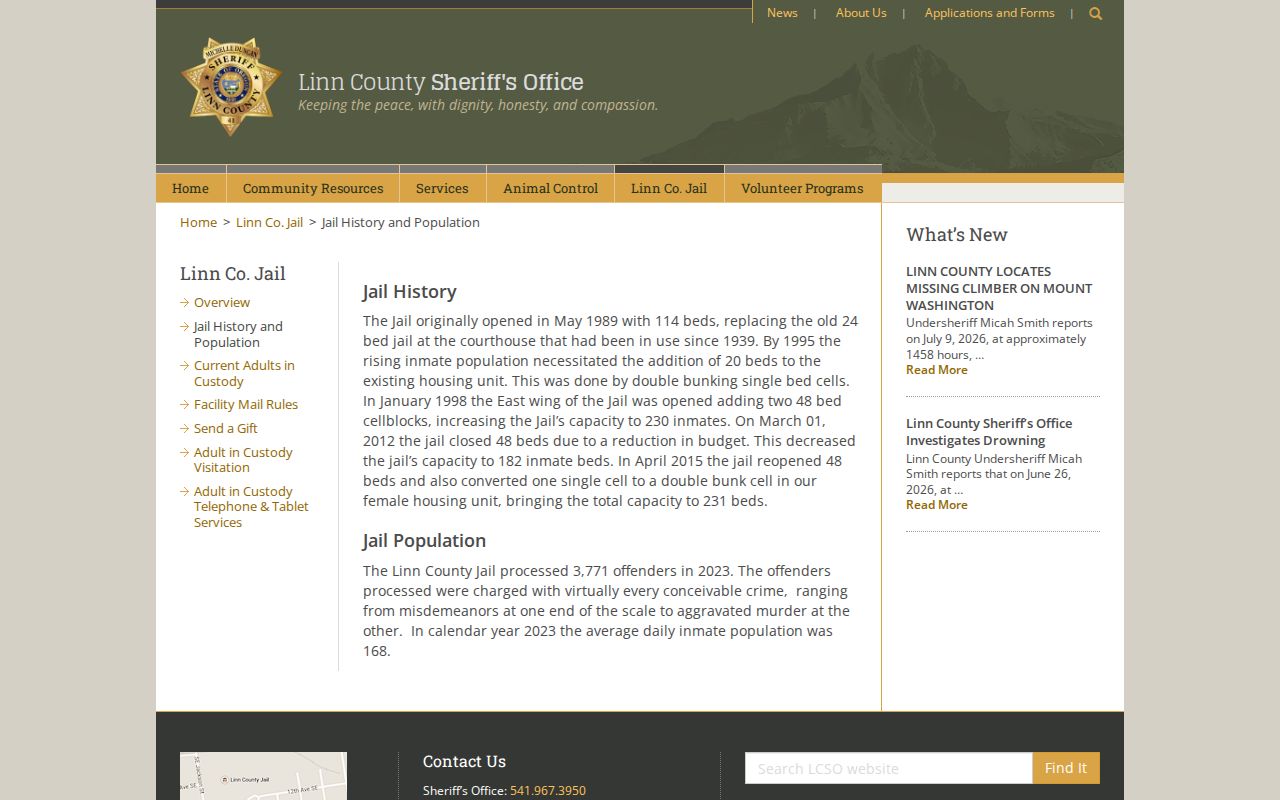
The history also helps keep the adult jail separate from the three youth custody and transition functions at the Oak Creek campus.
Linn Release Search and Jail Turnover
LCSO reports 3,771 offenders processed in 2023 and an average daily population of 168. “Processed” is a throughput measure, not a release count. It includes jail activity that must not be relabeled as community releases.
The figures still explain why the current roster turns over and why an exact historical window needs a records request. Comparing today's names with memory cannot reconstruct transfers, new bookings, repeat bookings, or the precise time each local custody event ended.
Linn County Release Facilities
Linn County has one identified public adult detention facility and three distinct youth custody or transition programs. Each uses a different confirmation path. Youth information may be confidential and is not available through the adult roster.
- Linn County Jail holds pretrial and sentenced adults; confirm exits through LCSO, VISOR, the court, or a receiving authority.
- Linn-Benton Juvenile Detention Center uses juvenile court and probation channels for conditional release.
- Oak Creek Youth Correctional Facility is an OYA secure facility with OYA transition and parole or probation paths.
- Jackie Winters Transition Program is a secure OYA transition placement, not proof of unrestricted community discharge.
The adult and youth systems must not be merged. A move among Oak Creek programs can be a placement change while custody continues.